
By Romain Lavrilloux — founder, Olive Private Label Studio, Córdoba (Andalusia). Last updated: 2 October 2026.
Producing one kilo of olive oil in Spain costs between €3.08 and €5.31, depending entirely on how the grove is planted and whether it is irrigated. In late July 2026, extra virgin olive oil traded at origin at €3.57/kg according to the Spanish Ministry of Agriculture and €3.42/kg according to Poolred — the lowest level in over two years. At those prices, hedge and irrigated intensive groves remain profitable, while every traditional grove model in Spain is producing at a loss. This guide sets out the full cost structure, the current market prices, why the two diverge, and what it means if you are sourcing olive oil or building a private label brand.
October 2026 update: the first official harvest estimate
Spain’s Ministry of Agriculture published its first estimate for the 2026/27 campaign on 1 October: 1,602,596 tonnes, 23% above the previous campaign. Andalusia accounts for 1,261,200 tonnes, led by Jaén (575,000 t) and Córdoba (339,700 t), according to the Junta de Andalucía’s aforo of 29 September.
That lands at the bottom of the 1.6–1.7 million tonne range the trade was anticipating in August, consistent with the field reports of weaker flowering fertility cited below. It is a first estimate: weather over the coming weeks will move the final figure.
Origin prices have barely moved since July. In the week of 19–25 September, extra virgin traded at €3.39/kg on Poolred, against €3.42/kg in late July. The lower grades rose instead, which has halved the premium for extra virgin over virgin, from about 27 to 13 cents a kilo.
| Poolred origin price | Late July 2026 | 19–25 September 2026 |
|---|---|---|
| Extra virgin | €3.42/kg | €3.39/kg |
| Virgin | €3.15/kg | €3.26/kg |
| Lampante | ~€2.90/kg | €3.15/kg |
The cost picture below is unchanged. At €3.39/kg, only hedge groves and irrigated intensive cover their AEMO production cost. A harvest nearly a quarter larger now arrives in a market where most Spanish grove surface already sells below cost: that adds supply pressure, but it does not by itself set the price.
Origin prices move every week. We publish them month by month, with the full series since September 2025, in our Spanish olive oil price tracker.
Sources: Ministry of Agriculture, first aforo 2026/27 (1 October 2026); Junta de Andalucía, aforo del olivar (29 September 2026); Poolred, week of 19–25 September 2026.
What it costs to produce a kilo of olive oil in Spain
The Spanish Association of Olive Municipalities (AEMO) publishes the reference cost study for Spanish olive growing. Its 2026 edition prices seven distinct cultivation models. The spread between them is wider than most buyers realise.
| Cultivation model | Cost per kg of oil |
|---|---|
| Hedge (seto), irrigated | €3.08 |
| Hedge (seto), rainfed | €3.17 |
| Intensive, irrigated | €3.20 |
| Intensive, rainfed | €3.52 |
| Traditional, mechanisable, irrigated | €4.18 |
| Traditional, mechanisable, rainfed | €4.67 |
| Traditional, non-mechanisable (mountain) | €5.31 |
Source: AEMO, Estudio de Costes del Cultivo del Olivo, 2026 edition.
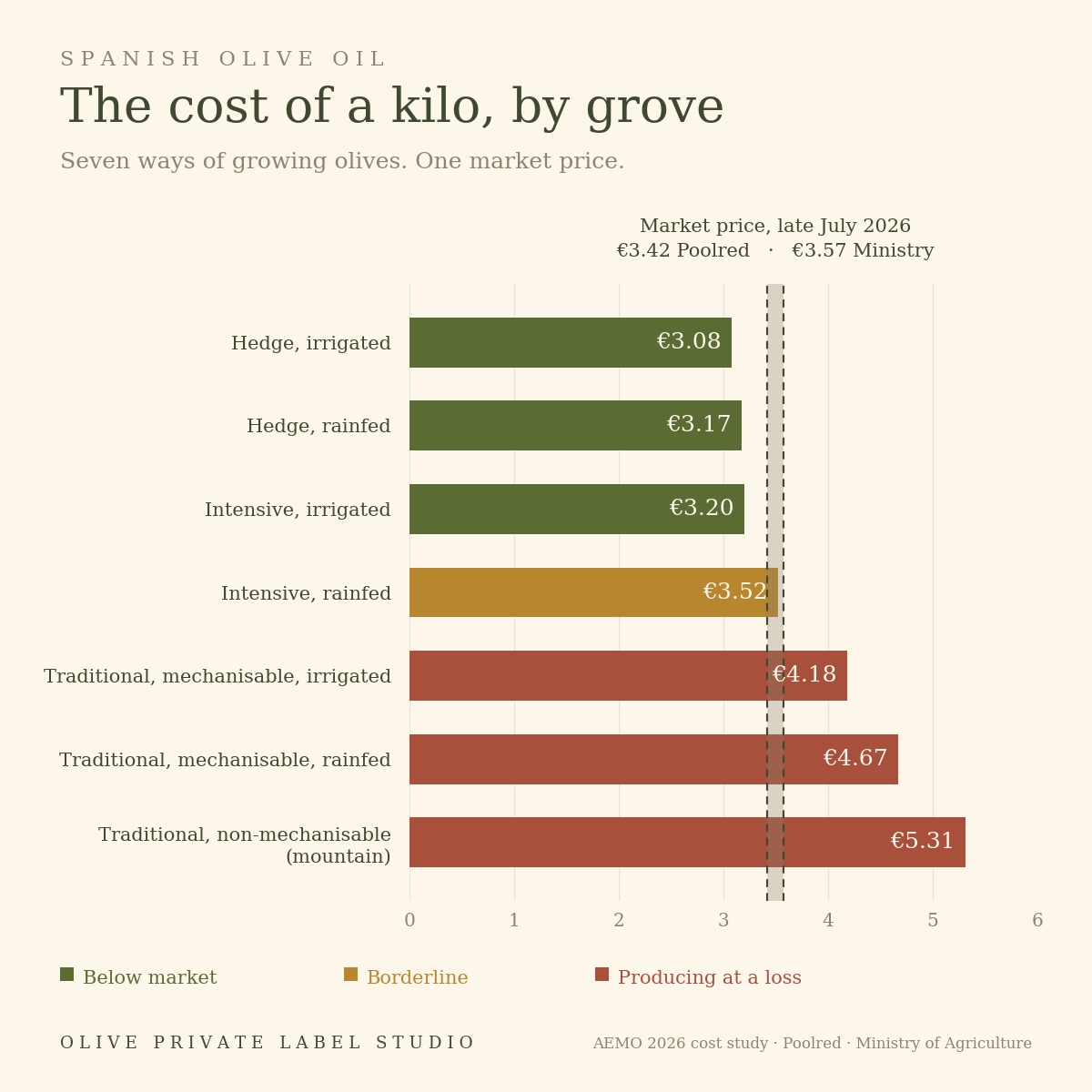
The gap between the cheapest and the most expensive model is €2.23 per kilo — a 72% difference for what reaches the shelf as the same product category.
Two things explain that spread. The first is planting density. Hedge groves (olivar en seto) carry more than 1,000 trees per hectare and are harvested mechanically by straddle machines. Traditional mountain groves may carry fewer than 100 widely spaced trees per hectare on slopes that no machine can climb, so they are harvested by hand. The second is water. Irrigation raises yield per hectare enough to dilute fixed costs across more kilos.
AEMO added rainfed hedge groves as a new category for the first time in its 2026 edition, in response to how quickly that model has spread. That addition is itself a signal about where Spanish olive growing is heading.
Why production costs have risen so sharply
AEMO puts the accumulated increase in cultivation costs at roughly 57% since 2020. The drivers are the same ones affecting European agriculture generally: labour, energy, fertiliser and machinery.
Labour matters disproportionately in olive growing because harvest is compressed into a few weeks and, in traditional groves, cannot be mechanised. A mountain grove that requires hand-picking is exposed to wage inflation in a way a hedge grove simply is not.
What olive oil actually sells for at origin right now
Origin prices — the price paid at the mill gate, before bottling, branding and distribution — are tracked by two main references in Spain.
| Reference | Category | Price (late July 2026) |
|---|---|---|
| Ministry of Agriculture | Extra virgin | €3.57/kg |
| Poolred | Extra virgin | €3.42/kg |
| Poolred | Virgin | €3.15/kg |
| Poolred | Lampante | ~€2.90/kg |
Sources: Spanish Ministry of Agriculture weekly bulletin; Poolred (Fundación del Olivar), last week of July 2026.
These are the lowest origin prices in more than two years. For context, origin prices peaked around €7/kg during the 2023–24 drought, and stood at €3.80/kg as recently as the week of 22–28 June 2026. The decline has been steady rather than sudden.
The two references differ because they measure different things. Poolred records actual bulk transactions registered by the system in the previous week and applies a volume-weighted moving average. The Ministry bulletin draws on a broader set of declared operations. A 15-cent gap between them is normal.
Why there is no single “price of olive oil”
Three distinctions matter when someone quotes you a figure, and confusing them is the most common error in olive oil sourcing.
Category. Extra virgin, virgin and lampante are different products with different prices. Lampante must be refined before it is edible. A headline price is meaningless without the category attached.
Origin price versus export price. Origin price is bulk oil at the mill. Export price includes bottling, packaging, certification and logistics, and typically runs several euros higher per kilo. Figures around $7–8/kg quoted for Spanish exports are not comparable to the €3.42/kg origin price.
Weighted average versus specific lot. AEMO cited a weighted average origin price near €3.26/kg across all categories. That is not the price of extra virgin, which sits above it.
Why most of Spain is now producing below cost
Set the cost table against the price table and the picture is stark.
At €3.42/kg (Poolred), only hedge groves are comfortably profitable. Irrigated intensive at €3.20/kg holds a thin margin. Rainfed intensive at €3.52/kg has crossed under. Every traditional model — from €4.18/kg to €5.31/kg — is losing money on every kilo produced.
At €3.57/kg (Ministry), rainfed intensive returns to a marginal profit. The dividing line sits precisely between those two reference prices, which is why the same week can be described as profitable or loss-making depending on which source is used.
AEMO’s conclusion is that more than 75% of Spanish olive grove surface is now producing at a loss or close to unviability.
The paradox: a sector in crisis that still produces record volumes
Spain produced roughly 1.3 million tonnes of olive oil in the 2025/26 campaign. How can three quarters of the sector be underwater while output remains high?
Because surface area and volume are not the same thing.
Traditional groves cover an enormous share of Spanish olive land — much of it in mountain and marginal terrain where nothing else grows economically. But they yield relatively little oil per hectare. Hedge and intensive groves occupy far less ground and produce far more per hectare.
So the groves that cover the most land are not the groves that fill the most tanks. Spanish olive growing can be simultaneously in crisis measured by area and productive measured by volume. Both statements are true, and confusing them produces a great deal of bad analysis.
This has a direct consequence for buyers. The price you are quoted quietly tells you which of these two industries your oil comes from — and most first-time buyers never ask.
Why prices have fallen: four factors
1. Expectations of a large 2026/27 harvest
Favourable spring rainfall led much of the trade to anticipate a strong coming harvest, with consensus estimates circulating around 1.6 to 1.7 million tonnes. Markets price expectations, not just current supply.
The first official estimate, published on 1 October 2026, came in at 1,602,596 tonnes — at the bottom of that range, and consistent with preliminary field data that had pointed to a significant decline in flowering fertility. It remains a first estimate, and the final figure will move with the weather.
2. High stock levels
Spanish stocks stood at 682,300 tonnes at the end of June 2026 according to AICA. Four provinces hold roughly 80% of it: Jaén (160,000 t), Córdoba (102,000 t), Sevilla (48,000 t) and Granada (22,500 t).
3. Import volumes
Spain had imported 202,000 tonnes of olive oil by the end of June 2026 — 92% of the volume forecast for the entire campaign, with four months still to run, and 20% above the five-campaign average.
Most arrives from Tunisia, through two routes: the EU’s annual tariff-free quota of 56,700 tonnes, and the inward processing regime (régimen de perfeccionamiento activo), which allows tariff-free import provided the oil is re-exported within six months. In the first four months of 2026, 96% of authorised Tunisian oil entered under inward processing.
Producer associations argue that each imported tonne displaces a tonne that would otherwise have been bought from a Spanish mill. Tunisian industry representatives counter that the discount reflects a financing problem rather than a quality one: weak local banking leaves Tunisian mills short of cash at peak harvest, forcing them to sell early and cheaply, and Tunisia complies fully with International Olive Council standards while being the world’s leading exporter of certified organic olive oil.
Both readings can be true simultaneously.
4. Buying patterns of large packers
Producer organisations COAG, UPA and OliveA have alleged that large bottling companies buy heavily early in the campaign and then pause purchases, leaving growers holding stock and under pressure to sell below cost.
Spain’s Food Chain Law (Ley de la Cadena Alimentaria) prohibits selling below production cost, and producer bodies are increasingly invoking it. Whether or not you accept this reading, it carries a practical implication for buyers: the discount you are offered may say more about someone else’s cash position than about the oil itself.
What this means if you are buying olive oil
Today’s entry point is genuinely favourable — with a caveat
For anyone building an olive oil brand, current origin prices represent the most favourable cost base in roughly three years. That is real.
But a market trading below the production cost of most of its supply base is unstable by definition. It resolves in one of two ways: consolidation at origin, as unviable groves are abandoned or bought up, or a price correction upward. Nobody credible is predicting which, or when.
The practical conclusion is not “buy now because it’s cheap.” It is: do not build your business case on the assumption that €3.42/kg is the new normal. Build it on a producer relationship that survives either outcome.
Choose the grove model that matches your positioning
The cost table is also a positioning table.
Hedge and intensive groves deliver volume, batch-to-batch consistency and a predictable harvest window, at €3.08–3.52/kg. This is the right answer for retail private label at scale, for foodservice, and for any programme where reliability of supply matters more than narrative.
Traditional and mountain groves deliver landscape, heritage, frequently a PDO designation, and oils with sensory characteristics a trained buyer can distinguish. At €4.18–5.31/kg to produce, they only make sense for premium positioning — and paying below that range means someone in the chain is absorbing a loss that will not be absorbed indefinitely.
Neither model is superior. But paying a hedge price while expecting a mountain product is one of the most common ways private label projects quietly fail. The oil arrives, it is technically compliant, and it does not taste like the sample that sold the project internally.
The seasonal window most buyers miss
September and October are structurally the tightest weeks in the olive oil calendar. The previous crop is depleted and the new one is not yet in. Premium lot availability is at its narrowest and spot-price risk at its highest.
The 2026/27 harvest begins in late October in Andalusia, with the bulk running from November to January. A brand aiming for new-harvest oil, bottled under its own label, on shelf in Q1 2027, needs producer selection, sample validation, packaging and compliance completed before the mills are running at capacity.
Frequently asked questions
How much does it cost to produce a kilo of olive oil in Spain?
Between €3.08 and €5.31 per kilo, according to AEMO’s 2026 cost study. Hedge groves under irrigation are cheapest at €3.08/kg; traditional non-mechanisable mountain groves are the most expensive at €5.31/kg. The difference comes down to planting density, mechanisation and irrigation.
What is the current price of olive oil at origin in Spain?
In the week of 19–25 September 2026, extra virgin olive oil traded at €3.39/kg at origin according to Poolred, 20% less than a year earlier. Virgin stood at €3.26/kg and lampante at €3.15/kg. We update these figures every month in our Spanish olive oil price tracker.
Why is olive oil so cheap in 2026?
Four factors combine: expectations of a large 2026/27 harvest following good spring rainfall, high carry-over stocks of 682,300 tonnes at the end of June, import volumes reaching 92% of the full-campaign forecast by June, and — according to producer organisations — buying patterns by large packers that concentrate purchases early and then pause.
Is Spanish olive oil currently sold below production cost?
For most of the sector, yes. AEMO states that more than 75% of Spanish olive grove surface is producing at a loss or close to unviability at current prices. Hedge and irrigated intensive groves remain profitable; all traditional models do not.
Will olive oil prices go back up?
Nobody can say with confidence. A market below the production cost of most of its supply base is structurally unstable and resolves either through consolidation at origin or through a price correction. The first official 2026/27 estimate, published on 1 October, puts the harvest at 1.60 million tonnes, 23% above last campaign — which adds supply pressure rather than relieving it.
What is the difference between origin price and export price?
Origin price is bulk oil at the mill gate, before bottling, branding, certification and logistics. Export price includes all of those and typically runs several euros higher per kilo. Comparing an export figure with an origin figure is the single most common source of confusion in olive oil pricing.
Sources
- AEMO (Asociación Española de Municipios del Olivo), Estudio de Costes del Cultivo del Olivo, 2026 edition
- Spanish Ministry of Agriculture, weekly olive oil price bulletin, last week of July 2026
- Poolred (Fundación para la Promoción y el Desarrollo del Olivar y del Aceite de Oliva), last week of July 2026
- AICA (Agencia de Información y Control Alimentarios), stock and production data to June 2026
- OliveA Tradición y Progreso, import and market statements, August 2026
Building an olive oil brand and want figures for your specific project? Tell us about your project — market, product, timing — and we’ll come back with a realistic price range and matched producer options. No commitment.